
Motivation: Putting Fear in Its Place
*Disclaimer: What motivates me, might not motivate you. Know Thyself.
Hello! It’s the middle of the last week of October, which means just 6 full days until NANOWRIMO takes over our lives. (If you don’t’ do NANOWRIMO, don’t worry; we still like you.)

So, I want to talk about motivation today and, hopefully, you’ll be prepared if you find yourself lacking…everything…come mid-November.
First of all, we need to know what motivation is. We give our story characters motivation, but do we ever wonder what our OWN motivation(s) is (are)?

Motivation is (1) the reason(s) we have for acting or behaving in a particular way; (2) the general desire or willingness we have to do something.
(mostly from dictionary.com)
The bad thing about being real humans instead of book characters is that we don’t know what our motivations are before we begin writing our stories, a.k.a. living life. We’re our own authors, and we aren’t privy to that information.
So, to find our motivation behind a specific behavior, let’s identify a behavior.
Here’s one: You are staring at a computer screen with all of this preparation around you—character arcs, plot cards, timelines, setting maps—and yet, your fingers hover over the keys like you know nothing at all.
No, I don’t have cameras in your house; I had only to go as far as my short-term memory.
The behavior that we want to analyze is the paralysis of moving forward. What’s the reason for this thought spiral that leaves us impotent?
If I were a betting woman, I’d lay down 50 cheese balls that some, if not all, of the following questions are floating around in your head:
- What if no one wants to read this story?
- What if my characters aren’t as cool in three months as I think they are right now?
- What if the plot is too small and thin?
- What if there is a plot hole I’m not seeing and I write the whole thing and I have to throw it away because of the big, fat hole?
- What if I get to the end of the story and only have, like, 10,000 words?
- What if I don’t have the grammatical background I need, and I don’t even know I’m making mistakes?
- What if I’ve picked the wrong POV?
- What if it just plain sucks?
- What if this isn’t my life’s calling?
- Why am I even doing this?
- Why am I not eating cheese balls?
All of these questions are spawned by one tiny, terrible word:
FEAR
It’s so little and looks so harmless—I mean, it only has 4 letters, but it should have 1 million with the way it takes over our lives.
Fear will stop you from doing ANYTHING that is not in your comfort zone. It’s supposed to keep us safe, and it will. We will not die if we stay as we are. (In most cases.)
BUT, what if you’re tired of your comfort zone? What if you want more than those four walls that box you in?
Fear is a natural response that happens when you’re trying to change things.
Think of it like this:
You don’t normally bungee off a mountain, but you have this notion that you might actually want to. This is a change from your normal, sidewalk-skipping ways, so your brain sends nervous electricity to your stomach, screwing with your bowels, and begins to yell “WARNING!!” to your consciousness, and all the sudden, you’re thinking:
- That mountain is so very high.
- Am I ready to potentially die?
- What if the straps are dry-rotted?
- What if there is a strong wind and I get off course?
- What if the instructor isn’t the crispiest lettuce in the salad?
- Why am I even doing this?
Looks a lot like the list of questions running through your mind right now as you stare at your blinking cursor, right? Why? Because deciding to write a book that may show the world your insides is kinda like deciding to bungee off a mountain, which, funny enough, may also show the world your insides. A really tall mountain. With really sharp rocks, and there’s no fog so you can clearly see all aspects of your death-fall.
(Dial it back, Mea.)

But here’s what I want you to know:
Fear is the consequence of change. We humans don’t do change well, and our minds will do anything to keep us in status quo, like allowing fear to spread like an epidemic until it consumes our thoughts and affects our actions.
I have a question for you.
What made you to do character arcs, plot cards, and setting maps? What about those behaviors and actions?
I think that we’re focusing on the wrong behavior. We wanna know why the blank screen, the blank mind, the veer toward procrastination, and all of the not-doing, but what if we focused on what spurred us to action when we loved what our hands touched? What thoughts were running through your head before the idea had pockmarks?
If I were a betting woman, I’d bet 54 gumdrops that it was something like this:
- What if there was this boy who could turn into a tree whenever he wanted to?
- What if she went to the moon BEFORE she discovered a planet?
- And there could be this plant that emits gamma rays…
- This character is the sh*t!
- I can’t believe that this came from my imagination!
- I am so pumped right now!
This is the behavior to analyze in order to discover your TRUE motivation, not the fear-focused one. This positive interaction with your creative side gives you strength, friend. When the hype dies, don’t let fear make you feel less than you are.
I’m not going to lie to you. Stepping past the fear-hurdle is not easy, and it’s a constant struggle.
I’ve had a little success with this. At the beginning of the year, I decided that I would OVERCOME all this oppression, and it was just that. I felt like I was lying prostrate with this huge fear-boulder covering the length of my back. I wanted to get up, to take a deep breath, but I couldn’t turn over.
I looked at my boys, at their beautiful, hopeful faces, and knew that I didn’t want them to be in their 30s and feel like this. I also knew that I couldn’t guide them to be better than me if I didn’t teach myself how to be better than I was right then. (You might have to read that sentence twice. It’s confusing but important.) Thus, the search to discover the “general desire or willingness to do something I want to do” commenced.
I made a plan, and implemented it. Here’s what I learned:
- I’m a do-nothing girl. That means that I can acknowledge that I have a personal need and do absolutely nothing about it. I have to fight my nature as well as my fear.
- I fight (present tense because it’s a war that won’t end) my nature by making a routine, on paper, and going through the checklist each day.
- I fight my fear by identifying who I want to be, professionally and personally, and figuring out why that is my ideal. For me, the initial desire was to be an example to my boys. That moved me to action. That’s an external motivator, a super good one, but I found that internal-motivation (wanting it for myself, too) is equally as important as external motivation.
The first line of defense against your fear is knowing the characteristics of the person you are now and the person you want to be, so you can define the reason you want to write.
This is the “general desire or willingness” the motivation definition talks about. Scribble them down. Post them somewhere, and when the fear blinds you from your dreams, look at your reasons. If they still ring true, if they calm you and revive the spark, sit down and write anyway.
Fear is spurred by change, right? So, make a writing routine part of your normal, so fear will shut the hell up.
But if your reasons don’t ring true anymore, you need more than motivation, friend. You need make sure this career path is right for you. And that’s okay. Why would you want to waste a moment more doing something that doesn’t feed your soul? If you leave writing alone for a while and decide you miss it, come back. Writing likes you. It’ll understand. And so will the writing community.

NANOWRIMO Tip 2017
NANOWRIMO Tip 2017
Pairing Backstory with Current Action: One Way to Save Your Credibility as an Author
Here’s some news: I’ve been editing three short stories to share with you lovely folks. Here is a tale about one of them.
I really love the beginning of this particular story as it was when I first wrote it. I had imagery, setting, a clever reveal sentence, and the word “carambola”. Too bad I HAD TO CHANGE IT.
I broke a little when I realized that the entire entry paragraph was…da, duh, duuuuummmm….info dumping.
As much as I loved, and I mean LOVED, those opening lines, these lovely words belonged to an experience in my MCs past, not the present issue she is currently dealing with.
You should know, I’m not an advocate of alleviating backstory (past experiences that affected your MC’s current personal outlook), just info dumping. I believe that instances in our own “backstory” as human beings fuel current actions/decisions we make today.
This makes them über important to us, and since our characters are human beings (or at least they should be) explaining aspects of their history is necessary for the reader to understand the character to the fullest. Your reader shouldn’t have to guess about why your character, for example, is afraid of water. They should be told that she almost drowned in the ocean as a small child. See how that works?
BUT
Nobody likes to be talked down to and, sometimes, that’s how dumping backstory feels. I read fiction to entangle myself into someone else’s life. Total immersion. Yet some backstory is presented like a textbook. I cannot entangle or immerse myself in a textbook. (If you can, you might be a robot.)
In a similar vein, I don’t like to be tricked as a reader, and if I would have left the first paragraph as is, I would have inadvertently tricked my readers with my misplaced story beginning. I would have started with a carambola and changed, rather quickly, to a much-older MC at a bus stop before readers could control their salivary glands.
As a writer, I want my readers to trust me to tell them a good story.
We can lose credibility if we don’t take care in mixing up the the story we are meant to tell with other stories in the character’s life.
So, a fellow writer posted in a Facebook writing group something to the effect of…
My MCs past is very important but I don’t know how to tell it without info dumping. She has depression/anxiety because of certain past events but the reader won’t understand the Now without knowing the Then.
I wanted to help as best I could, and my response piggy-backed (funny mental picture) another’s and went a little like this:
What about negative self-reflection? You get backstory but from an unreliable narrator, could be interesting. From my experience with depression, instances in my “backstory” repeat over and over, along with the emotions connecting them, like being slapped in the face over and over by shame/regret. Maybe “backstory” is fighting through rounds of these emotional battles created from a current stimulus. Sometimes I win; sometimes I lose. Maybe MC could, too?
The writer liked the idea, and I started to wonder why this tactic might work. This is what I decided:
Pairing backstory with a current action helps make the information relevant and digestible to your reader.
It keeps the reader in the story you’re telling instead of making him/her mentally halt all forward progress and rearrange the timeline in his/her head.
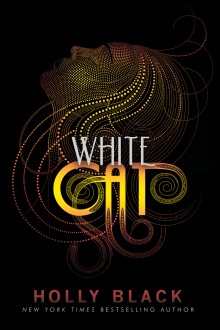
*Important Note* This is not an exclusive rule. In Holly Black’s White Cat, there was a present day stimulus that triggered a flashback. The story completely halted, switched to the past for backstory, before returning to present day. This worked for Black’s book, so there’s a text to study if you feel the need. Also, it’s a fabulous book.
Oh! Also, Poison Study by Maria V. Snyder. The flashbacks are well done here, too, and this story is aces.

Okay, that’s what I’ve been thinking about today! How about you?

Rejection, Take 2
OMG, IT HUUUUUUUURRRRRRRTTTTTTSSSSS!!!!!!!!!!!!!!!!!!!!!!!
WHAT DO YOU PEOPLE WANT FROM ME????
Oh, that’s right….
NOTHING!!!
Can I tell you a secret? I had this dream about getting an acceptance email, and I held onto it tightly, quietly. I pretended I didn’t expect rejections, but I didn’t expect all the rejections. It was the first time I put myself out there…
I’m fine. I’ll be fine. It’s just my ego. It hurts. In my experience, though, good things come shrinking the ol’ ego. So, I’ll be restructuring the poetry book and getting it ready to go out again after I finish the draft of All the Words.
Whine break is over. Time to get back to the work.

PROOF: Forging a Writing Life in Public
Hello, there!
If you’re reading this blog, you may be interested in witnessing the perils and pleasures of writing toward authorship. Well, that’s what I’m here for! This whole thing documents the concentrated effort of storying (WordPress doesn’t like this word, but I DO!) and will include the process toward publication after the blood has dried, along with some other adventures on the way!
Acting on the desire to write for publication is the coolest and hardest thing I’ve ever tried to do for myself. It’s so easy to put off one’s personal aspirations to deal with life’s necessities, and at times, I even forget that I’m allowed to dream. Then, the haze of fatigue rises, I’m clear-headed and spry, and I nudge this Want awake with shaky fingers.
To my surprise, the more often I wake the Want, the more it demands companionship. Forget this hibernation thing. Even cat naps are for suckers. Its preference (and mine) is full awareness, and I’ve got to say, I’m really enjoying the constant coaxing of Something More.
That paragraph makes writing sound all good-fairies-in-a-mossy-wood, but–Real Talk–perseverance is hard, y’all. Self discovery through writing eats all the leftovers from your emotional Tupperware. And we’ll talk about that, too. The good, the bad, and the dirty, dirty dishes.
You ready?

Holly Lisle Rocks My Writing World
About 4 years ago, I was googling writing things and ran across a lovely lady who didn’t try to blow wind in my sail about the perils and pleasures of writing. At the time, writing about writing wasn’t as common as now, and I didn’t know any local writers, and Lord, I was a prideful creature. After trying to figure out novel writing on my own for about 3 years, which subsequently whittled down my hubris to a mere stub, I went searching on the internet for a guide.
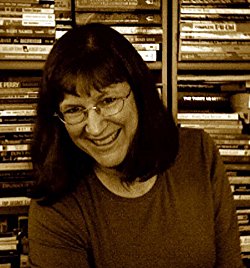
Her name is Holly Lisle, and I started with her blog. A dim light began illuminating my manuscript. I tried a small plot course. Hallelujah, planning starting making sense. I bought a novel-writing course on a payment plan, How to Think Sideways, and my writing life changed forever.
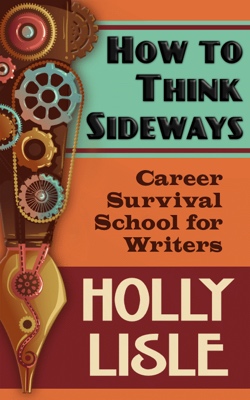
The book that I’d been writing bits and pieces of for almost three years, fell to bits, but I knew why, and I did better with the next try. I still pop back to certain lessons when my brain is goo and my stories feel like gooier goo. She’s written over 30 books, so I feel safe in her instructing hands, and she is so good at explaining how and why she does what she does. There are very few strategies that don’t work for me.


Above is a list of Holly’s books, excluding nonfiction. Click on the image to see up close!
I’m writing this because, when I take a course from her, I learn more than I did in my college creative writing course! (Perspective: It was an introductory creative writing course a thousand years ago, but still. I was surprised.)

It was my first venture investing in learning without a certificate or degree as an end result, and I was so pleased.
All this to say, when I received an email, explaining that there is a Holly Lisle patreon page, I was so happy! Here she is still giving to me continually, and finally I can give something back to her on a regular basis! I don’t have a lot, but she wasn’t asking for a lot. I wish I could hug her and tell her in person how she’s affected my life, but since that could be creepy, I put my conviction in a monthly donation.
I’m not asking you to do so (unless you love her, too); I just wanted to share my excitement! If you want to know more about Holly, I’ll leave some links below.
Holly’s Website: https://hollyswritingclasses.com/
Holly’s Blog: https://hollyswritingclasses.com/blog/
Holly’s Writing Courses: https://hollyswritingclasses.com/shop/
Holly’s Patreon: https://www.patreon.com/hollylisle/posts
Sharing the knowledge, people. Just sharing the knowledge.

A Surprising Response to Rejection
I got my first official rejection today. Honestly, it was a really nice stock letter.
Supportive.
Kind.
No, I don’t need ice cream. Not to sort through my feelings, but I’ll let you know if that changes.
Right now I’m just…surprised.
Not that I received a rejection letter. Rufus knows I expected that. I actually expect it will be the first of many.

No, I’m surprised that…
it hasn’t affected my feelings of being a writer.
Does that mean I’m kicked out of the club?
I almost feel bad that I don’t feel bad. I don’t know what this lack of negative feeling means.
The internet told that I would be devastated. That rejections would kill my confidence. That I’d be tempted to let these letters strangle the dream. That I’d be tempted to *gasp* quit.

But that isn’t what I’m feeling. Am I a robot?
Maybe, just maybe, I’ve spent years being fearful about this very thing that I’ve already experienced those emotions before I even pressed “submit”, and now…I’ve found I’m rather over it.
Maybe I’m stronger than I thought I was. Is this confirmation that I actually have confidence? Or that I’m just so completely abnormal?
Maybe the fact that I finished the project was enough of an achievement for me. I felt so much more about that moment than I’m feeling about this rejection.
I’m swimming in a pool of questions right this moment.
Here’s what I DO know:
I’m glad I submitted. The act of choosing to click that button made me realize that I’m ready to take this into my own hands. No more standing in the shadows waiting to be “discovered” by someone who thinks I’m something special. No more growing fungi in dark corners. I believe in the effort, emotion, and care behind each of my stories. I don’t think I knew that until my anti-climactic response to my first rejection letter.
Today, I’m…okay.
Hopefully, I’ll still be tomorrow.

Bleeding Truth – WIP

 Mea Smith